
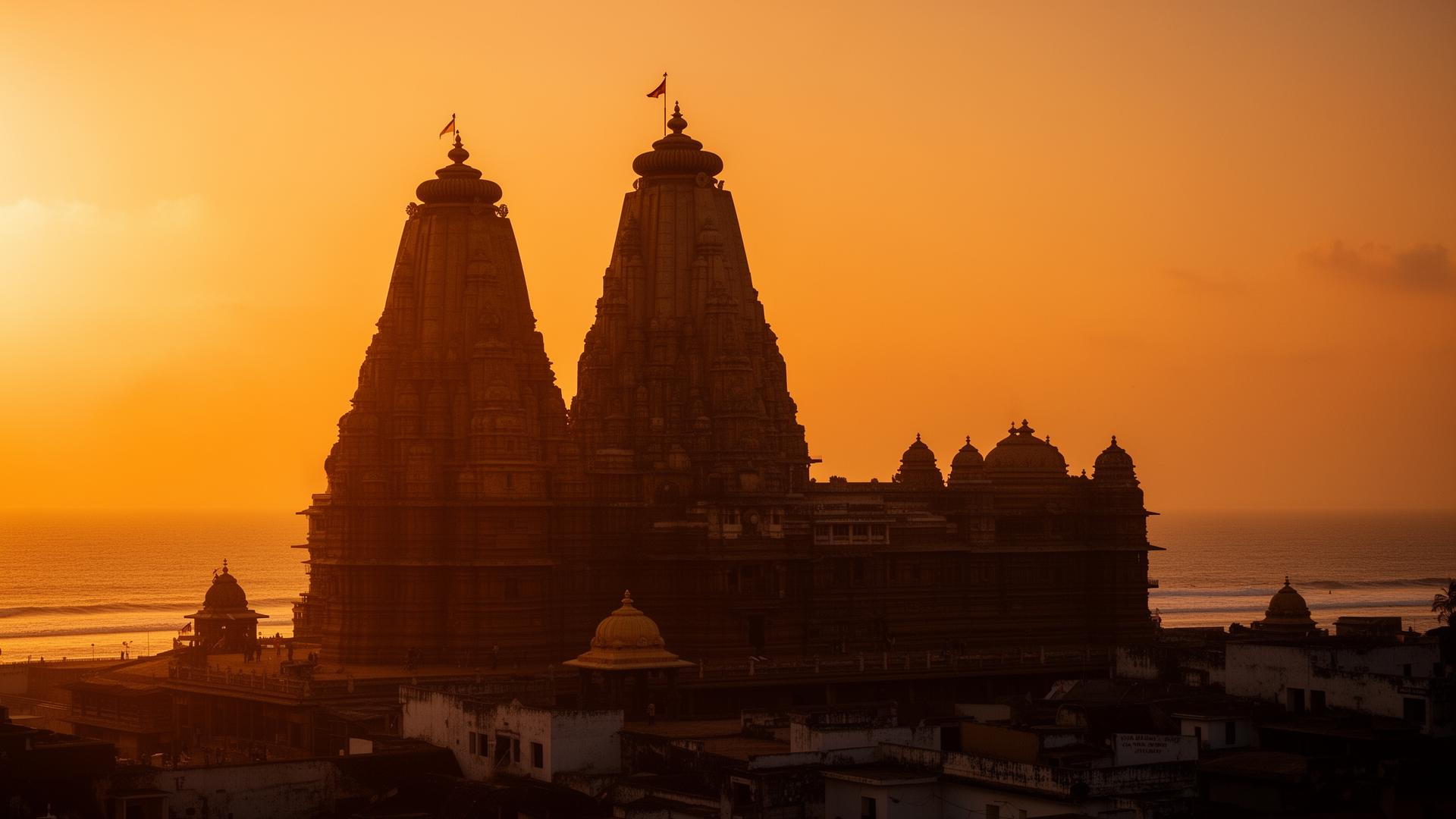
Of all the four Dhams of Bharat — Badrinath, Dwarka, Rameswaram, and Puri — only one carries the title of Mrityu Vaikunth. Only one is where the Lord himself is said to sit in eternal vigil over the dead. Only one has a cremation ground named Swargadwar — the Gateway to Heaven. That place is Shri Jagannath Puri, on the shores of the Mahodadhi (the Great Ocean), in Odisha.
For anyone performing Pind Daan, Tarpan, or Shradh for a departed ancestor, Puri represents the supreme destination. It is not merely a sacred site — it is the ultimate sacred site. And the reason lies in the extraordinary identity of its presiding deity: Lord Jagannath, the Lord of the Universe, in whose direct presence every ancestral rite performed here carries infinite weight.
Location
Puri, Odisha (60 km from Bhubaneswar)
Sacred Ocean
Mahodadhi — Bay of Bengal, where all holy rivers merge
Primary Pind Daan Site
Swargadwar Ghat — Gateway to Heaven
Presiding Deity
Lord Jagannath — Lord of the Universe (Purushottama)
Status
One of the Char Dham; the only Mrityu Vaikunth
Scriptural Authority
Skanda Purana, Brahma Purana, Padma Purana, Garuda Purana
Who Is Lord Jagannath? — The Lord of the Universe
The name Jagannath is composed of two Sanskrit words: Jagat (the universe, all that moves) and Natha (Lord, master). Lord Jagannath is the Lord of the entire moving universe. He is simultaneously Vishnu, Krishna, Brahman, and the supreme formless reality — but at Puri, he manifests in a form unlike any other deity in all of Sanatan Dharma: carved in wood, with large round eyes and arms that are incomplete — as if eternally reaching out to embrace all of creation.
Inside Srimandir (the Jagannath Temple), Lord Jagannath is enshrined alongside his elder brother Balabhadra and his sister Subhadra, with the sacred Sudarshan Chakra. These four deities together represent the four-armed, cosmic form of the Supreme. The Skanda Purana calls this sacred complex the Purushottama Kshetra — the land of the Supreme Person.
What makes Jagannath uniquely relevant to Pind Daan is his nature as Purushottama — the one who transcends both the perishable and the imperishable. The Bhagavad Gita's 15th chapter declares Purushottama to be beyond both the living and the dead — the master of both worlds simultaneously. Performing ancestral rites in the presence of such a deity carries a magnitude that cannot be replicated anywhere else.
The Origin Story — From Nila Madhava to the Lord of the Universe
Part I: King Indradyumna and the Search for Purushottama
The origin story of Lord Jagannath is one of the most beautiful narratives in all of Puranic literature. It is told in the Skanda Purana's Purushottama Kshetra Mahatmya and the Brahma Purana's Narada Khanda — among the most authoritative Puranic texts in existence.
In Satya Yuga, there was a great king named Indradyumna who ruled the kingdom of Avanti. He was a deeply devoted Vaishnava who was consumed by one desire: to behold the Supreme Lord with his own eyes. One day, a wandering pilgrim arrived and spoke: "O king, there is a place in Odra Desha (Odisha), on the shores of the Southern Ocean. Mount Nilagiri stands there, and on that mountain, in a hidden cave, there is a deity called Nila Madhava — the Blue Lord — being secretly worshipped by a tribal king named Vishwavasu."
Hearing this, King Indradyumna was moved to his core. He sent emissaries to find Nila Madhava. After great difficulty, one emissary — the Brahmin Vidyapati — managed to trace the deity's location, guided by Vishwavasu's own daughter Lalita.
Part II: Vishwavasu — The Tribal Guardian of Nila Madhava
The figure of Vishwavasu is central to the Jagannath origin story. He was the king of the Shabara tribe — a forest-dwelling people of Odisha who lived on the slopes of Nilagiri. He had been worshipping Nila Madhava in a hidden cave with total, single-minded devotion.
When Vidyapati was brought to see Nila Madhava, the deity was so magnificently beautiful — dark blue, with the luminosity of a thousand suns — that Vidyapati was overwhelmed. He secretly dropped a mustard seed along the path to remember the way back. But when he returned with King Indradyumna's invitation, they found that the deity had disappeared from the cave.
Part III: The Divine Voice and the Sacred Log
King Indradyumna performed a massive Ashwamedha Yajna at the sea shore and prayed desperately for the Lord's return. Then came a divine voice from the sky — Akasha Vani: "O King, go to the sea shore and you will find a fragrant log of wood (Daru Brahman) floating on the waves. From that sacred wood, have the image of the Lord carved."
The divine craftsman Vishwakarma appeared in the form of an old man, saying he could carve the images on one condition: he would work alone, behind closed doors, and no one should open the door until he said so. For days, the sound of chisels came from inside. Then, suddenly, silence. The king's queen, worried the craftsman had died inside, convinced the king to open the door. Inside, they found three wooden images — Jagannath, Balabhadra, and Subhadra — their forms incomplete, their arms unfinished.
King Indradyumna was grief-stricken. But again the divine voice spoke: "These forms are my will. The incompleteness is my perfection. Install them exactly as they are. I, Purushottama, dwell in them fully." And so the world-famous wooden idols of Jagannath, Balabhadra, and Subhadra — with their large round eyes and incomplete arms — were installed at Puri. They remain there to this day, renewed every 12–19 years in the sacred ritual of Nabakalebara.
The Theology of Incompleteness
Lord Jagannath's incomplete form is not an accident of legend — it is a theological statement. The Lord's arms are unfinished because he is always reaching out — to all of creation, to the highest and the lowest, to the brahmin and the tribal, to the living and the dead. The large round eyes are those of someone who sees everything — the entire Jagat (universe), simultaneously and completely. This is why performing Pind Daan in his presence carries such extraordinary weight: nothing escapes his sight, and no sincere ancestral offering goes unwitnessed by the Lord of the Universe.
Purushottama Kshetra — The Land of the Supreme Person
Long before the current Jagannath Temple was built — before the Ganga Dynasty's King Anantavarman Chodaganga Deva constructed the magnificent stone temple in the 12th century CE — this land was already known as Purushottama Kshetra. The Skanda Purana, the Narada Purana, and the Matsya Purana all refer to it by this name, affirming that the sacred presence of Purushottama predates the physical temple by millennia.
The land of Puri is described in the Skanda Purana's Purushottama Mahatmya as a place where the Lord himself is always present — not as an image, not as an idea, but as a living, breathing divine reality. The text says: "In this kshetra, there is no death — only transformation. Every soul that departs from Purushottama Kshetra attains the Lord's own abode."
Adi Shankaracharya — the 8th-century reformer who established the four Mathas to guard the four Dhams — chose Govardhan Math at Puri as the eastern guardian of Sanatan Dharma. Shankaracharya recognized Puri as one of the four cardinal points of the Hindu sacred cosmos.
Mrityu Vaikunth — Why Puri Is Unlike Any Other Dham for the Departed
Vaikunth is the supreme abode of Lord Vishnu — the realm of eternal bliss and liberation. Mrityu Vaikunth is different. It is Vaikunth on Earth — a physical place where the energetic reality of Vaikunth is fully present in the living world. The Puranas declare that Shri Jagannath Puri is such a place: the only Mrityu Vaikunth in all of Bharat.
When a soul's last rites are performed at Puri, it is done in the direct energetic field of Vaikunth itself. The barriers between the living and the dead are thinner here than anywhere else on earth. The departed soul, receiving the Pind Daan in this field, receives liberation not merely from the suffering of the ancestral realm but from the cycle of birth and death itself.
श्रीक्षेत्रे यः पिण्डं दद्यात् पितृभ्यः श्रद्धयान्वितः। स तारयति पूर्वांश्च भविष्यान् सप्त सप्त च॥
"Whoever offers pind at Shri Kshetra (Puri) with shraddha redeems seven generations past and seven to come — such is the power of the ultimate Mrityu Vaikunth."
— Padma Purana
Swargadwar — The Gateway to Heaven
Of all the sacred sites within Puri, Swargadwar is the most directly relevant to Pind Daan. The name is explicit: Swarga (heaven) + Dwar (gate, door). It is the threshold between the mortal world and the celestial realm — literally the door through which souls pass into heaven.
Swargadwar is the traditional cremation ground of Puri, located directly on the sea shore of the Mahodadhi. For thousands of years, pilgrims from all over India have brought their dead here — believing that any soul cremated at Swargadwar automatically attains Swarga. The very act of cremation at this ghat, in the sacred presence of Lord Jagannath, is said to bypass the karmic ledger and grant the soul direct passage to a higher realm.
This is also the primary site for Pind Daan at Puri. The Mahodadhi — the Great Ocean — receives the Pindas, the Tarpan water, and the ashes of the departed. The Puranas declare that all holy rivers ultimately flow into the Mahodadhi. By offering Pind Daan at Swargadwar, you are offering at the confluence of all sacred waters simultaneously.
महोदधौ यः स्नाति पितृभ्यस्तर्पणं ददेत्। स मुच्यते सर्वपापैः पितरश्च विमुक्तये॥
"He who bathes in the Mahodadhi and offers Tarpan to the ancestors is freed from all sins — and his ancestors too attain liberation."
— Skanda Purana, Purushottama Mahatmya
Sacred Sites in Puri for Pind Daan
What the Scriptures Say — Six Major Texts
Skanda Purana — Purushottama Kshetra Mahatmya
The Skanda Purana — the largest of all 18 Maha Puranas — dedicates an entire section to the glorification of Puri. It describes Puri as the eternal abode of Purushottama and declares that Pind Daan performed here redeems multiple generations.
Brahma Purana — The Indradyumna Narrative
The Brahma Purana provides the most detailed account of Lord Jagannath's origin — the full story of King Indradyumna, Nila Madhava, Vishwavasu, and the creation of the sacred wooden idols.
Padma Purana — Seven Generations
The Padma Purana contains one of the most explicit declarations about the power of Pind Daan at Puri: whoever offers pind at Shri Kshetra with devotion redeems seven generations past and seven generations to come.
Garuda Purana — The Authority on Pind Daan
The Garuda Purana describes Puri as one of the supreme kshetras for ancestral rites. It specifies that Tarpan offered in the Mahodadhi reaches all ancestors, since all rivers merge into the Great Ocean.
Narada Purana — Purushottama Tirtha
The Narada Purana refers to Puri as Purushottama Tirtha — the pilgrimage site of the Supreme Person — and places it among the highest Vaishnava sacred sites in all of Bharat.
Matsya Purana — Vishnu's Own Dwelling
The Matsya Purana confirms that Purushottama Kshetra is the living earthly abode of Vishnu — a place where the Lord is present not just symbolically but in full divine reality.
Where Lord Jagannath Himself Honors Ancestors — Deba Deepawali and Shraddha Besha
There is a fact about Srimandir that is not widely known outside of Puri — and it may be the most profound reason of all for why Pind Daan at Jagannath Puri carries such extraordinary spiritual weight.
In the Srimandir tradition, Deba Deepawali and Shraddha Besha preserve a rare theological point: Bhagwan Jagannath is understood to honor His divine parents and the royal devotees connected with His manifestation. The Lord is adorned in a white Shraddha-related besha, and the temple tradition remembers ancestors across yugas.
This is the point Manish Bhai wanted highlighted: humans perform Shraddha, Bhagwan Ram performed Pind Daan, but Puri holds the tradition where Jagannath Himself models Pitru Seva. It presents Jagannath not merely as one avatara among many, but as Purushottama — the source before whom all avataras and all worlds stand.
When you perform Pind Daan at Jagannath Puri, you are performing it in the kshetra where ancestral duty is not treated as a social formality. It is honored in the Lord's own temple tradition. That is why Puri deserves a central place in any serious discussion of Pitru Dharma.
"Where the Lord of the Universe Himself honors ancestors, Pind Daan is not only a ritual — it becomes a divine precedent."
— Principle of Puri's Mrityu Vaikunth
Source note
This section is intentionally framed as Srimandir temple tradition. Once an exact Niladri Mahodaya, Madala Panji, Karmangi or Record of Rights page is available, the article can cite the page directly.
Read the Bhagavata and shastra proof
The Pind Daan Ritual at Puri — How It Unfolds
At Jagannath Puri, Pind Daan follows the same broad structure as at other sacred sites but carries unique Puri-specific elements that make the ritual especially potent. The ritual typically spans one full day.
Arrival and Purification
The pilgrim arrives at Puri and proceeds to the Mahodadhi (sea shore). The sacred bath in the Mahodadhi is the first act — an immersion in the Great Ocean into which all rivers flow. This bath cleanses the pilgrim and marks the formal entry into the sacred ritual space.
Darshan at Srimandir
Before performing the ancestral rites, the descendant seeks the darshan (sacred sight) of Lord Jagannath inside Srimandir. This darshan is a formal request to the Lord: 'O Purushottama, I am about to perform the shradh of my ancestor. Be my witness and bless the rites.'
Sankalp at Swargadwar
The Sankalp — the formal declaration of intent — is performed at Swargadwar Ghat, on the sea shore. The descendant's name, gotra, and the ancestor's name and gotra are declared before the sacred fire and the ocean witnesses.
Tarpan in the Mahodadhi
Facing the ocean, the descendant offers Tarpan — water mixed with sesame and kusha — to the devas, rishis, and pitrs in sequence. The offering goes directly into the Mahodadhi, reaching all ancestors simultaneously through the ocean's connection to all holy rivers.
Pind Daan on Swargadwar Sands
The Pindas — rice balls prepared with sesame, honey, ghee, and kusha — are offered on the sacred sand of Swargadwar beach, in the direct sight of the ocean and the Jagannath Temple. The Padma Purana declares that such an offering redeems seven generations past and seven to come.
Special Pind Daan Beside Srimandir
Sahi Pinddaan's world-first seva: Pind Daan is also arranged directly beside the Srimandir compound — in the immediate presence of Lord Jagannath. This unprecedented proximity to the Lord's own abode amplifies the ritual in ways that no other service in India offers.
Gau Daan and Visarjan
Gau Daan — the lifetime, non-commercial donation of a cow in the ancestor's name — is performed as part of the complete ritual. The Pindas are then offered into the Mahodadhi as Visarjan, releasing the ancestor's soul into the cosmic ocean of liberation.
Pitru Paksha at Swargadwar — The Most Auspicious Season
Every year, during the fortnight of Pitru Paksha (the dark fortnight of Bhadrapada, typically in September), Puri becomes one of the most concentrated spiritual spaces on earth. Lakhs of devotees arrive at Swargadwar to perform Pind Daan, Tarpan, and Shradh for their ancestors.
The Mahalaya Amavasya (the last day of Pitru Paksha) is considered the most potent day. On this day, performing Pind Daan at Swargadwar is said to grant liberation to even the most difficult ancestral cases: those who died unnatural deaths, those who died without any descendants, and those for whom no rites have been performed in many generations.
The combination of the most powerful sacred site (Swargadwar, Puri), the most powerful season (Pitru Paksha), and the most powerful method (authentic Vedic vidhi performed by sankalpit Brahmins) creates a window of ancestral liberation that the Puranas describe as truly without parallel.
World-First Seva — Pind Daan Beside Srimandir
For all of Puri's sacred potency, there was historically no arrangement for performing Pind Daan in direct proximity to Srimandir itself — within the immediate precincts of Lord Jagannath's own abode. Pind Daan was performed at Swargadwar (the sea shore) or at the various ponds and ghats within the city.
Sahi Pinddaan has created a world-first seva: the arrangement of a complete, authentic Pind Daan ritual directly beside the Srimandir compound — in the immediate presence of Lord Jagannath, away from the crowds and commercial chaos that often accompany the popular ghats.
This is not a modification of the ritual. The Pindas, Tarpan, mantras, and all elements of the vidhi remain 100% scriptural. What changes is the proximity: your ancestor receives the sacred offerings in the energetic shadow of the Lord of the Universe himself.
How to Reach Puri
By Air
Bhubaneswar (BBI) airport — 60 km. Direct taxis available.
By Train
Puri railway station — directly in the city. Trains from Kolkata, Delhi, Mumbai, Chennai.
By Road
NH-316 from Bhubaneswar to Puri — well-maintained, regular buses.
Swargadwar Location
On the sea shore, approximately 1.5 km from Jagannath Temple.
Best Time
Pitru Paksha (Sep–Oct), any Amavasya, or after a family member's passing.
Accommodation
Sahi Pinddaan arranges Sattvik lodging near the kshetra.
Begin the Seva
Arrange Pind Daan at Jagannath Puri
Sahi Pinddaan arranges authentic, complete Pind Daan at Jagannath Puri — including the world-first seva beside Srimandir, Swargadwar Tarpan, pure non-commercial Gau Daan, and end-to-end arrangement by sankalpit Vedic Brahmins. Proxy Pind Daan with live video available for families who cannot travel.
Available daily · 7 AM – 9 PM IST · Shastra-approved Proxy Pind Daan also available